
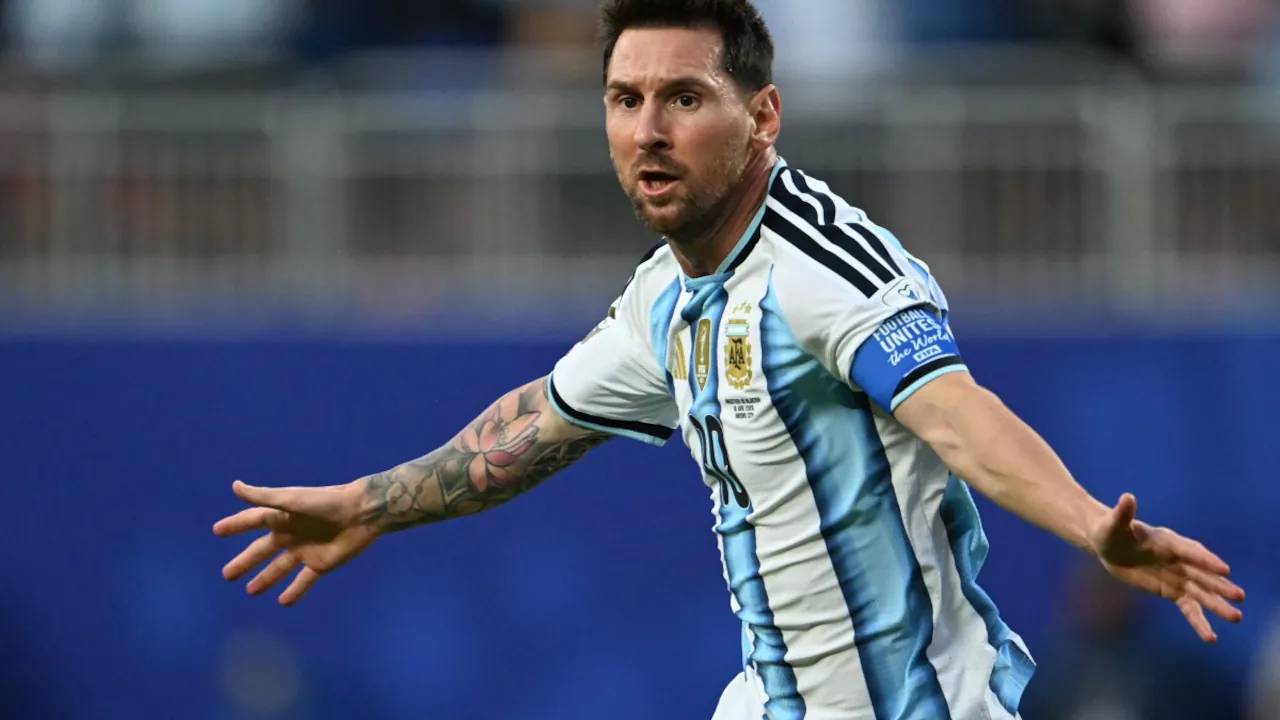
For many footballers, the age of 39 marks the twilight of their careers. Speed declines, and the body no longer cooperates as it once did stars who once struck fear into opponents gradually fade from the pitch. Yet, Lionel Messi has defied all these conventions. Even if he no longer wins matches through sheer sprinting, he dictates the flow of the game to his own rhythm using his intellect and profound understanding of the sport. That is why, even at 39, he remains the most dangerous player in world football.
Messi once again demonstrated his extraordinary impact during Argentina’s 2-1 victory over England in the 2026 World Cup semi-final. Although he did not score a goal himself, he completely altered the course of the match with two assists. As the final whistle blew, Messi sank to his knees on the pitch, overcome with emotion. Witnessing such raw emotion from a player who has already won the World Cup, eight Ballon d’Or awards, and countless other trophies revealed just how special every victory remains to him.
England’s strategy worked brilliantly for the first hour of the match. Instead of assigning a specific player to man-mark Messi, coach Thomas Tuchel ensured he was denied space through the collective efforts of Elliott Anderson, Jude Bellingham, and Declan Rice. Consequently, Messi was unable to receive the ball in dangerous areas. England took the lead early in the second half with a goal from Anthony Gordon, feeling at that point that they had the match firmly under control.
However, Messi completely shifted his game. Instead of operating from the center, he moved to the right wing to orchestrate play. Whenever he received the ball, England players would rush to close him down, creating gaps elsewhere on the pitch—spaces that Argentina exploited effectively. In the latter stages of the match, Messi recorded 94 touches, completed nine successful dribbles, and created four key chances; these statistics highlight the immense impact he had on the game.
Messi was also the architect behind the equalizer scored by Enzo Fernández in the 85th minute. Receiving the ball on the right, he remained composed, drawing the English midfield towards himself before delivering a brilliant pass to Fernández at the perfect moment. Similarly, a precise cross from Messi laid the foundation for Lautaro Martínez’s winning goal in stoppage time.
Interestingly, Messi did not score a goal in this match; his ‘Expected Goals’ (xG) value was a mere 0.01—an unusually low figure for a tournament’s top scorer. Yet, this served as further proof that Messi’s influence cannot be measured by goals alone. Once known for dribbling past opponents, he has now evolved to a level where he manipulates opposition positioning to create opportunities for his teammates; analysts praise this as a testament to his football IQ.
The most significant change in Messi’s game today is his adaptability. While he once tore through defenses with sheer speed as a young player at Barcelona, he has now transformed into a conductor who dictates the tempo of the match. While teammates like Alexis Mac Allister, Enzo Fernández, Rodrigo de Paul, and Julián Álvarez cover vast distances by running, Messi conserves his energy for pivotal moments. When the situation demands it, he can swing the match in Argentina’s favor with a single pass or a decisive move. With two assists in this World Cup, his tally now stands at a record-breaking 12 assists and 21 goals in World Cup history. Achieving these figures across six World Cups is a testament to his remarkable consistency.
Now, his final challenge lies ahead: Spain. Messi is preparing to face a Spanish squad brimming with young stars like Lamine Yamal, Pau Cubarsí, and Dani Olmo. The legend who once defined Barcelona is set to clash in the World Cup final against the new generation representing that very same club. The match against England proved one thing clearly: while it is possible to contain Messi for an hour, controlling him for the entire duration of a match remains a daunting task for any team in the world.