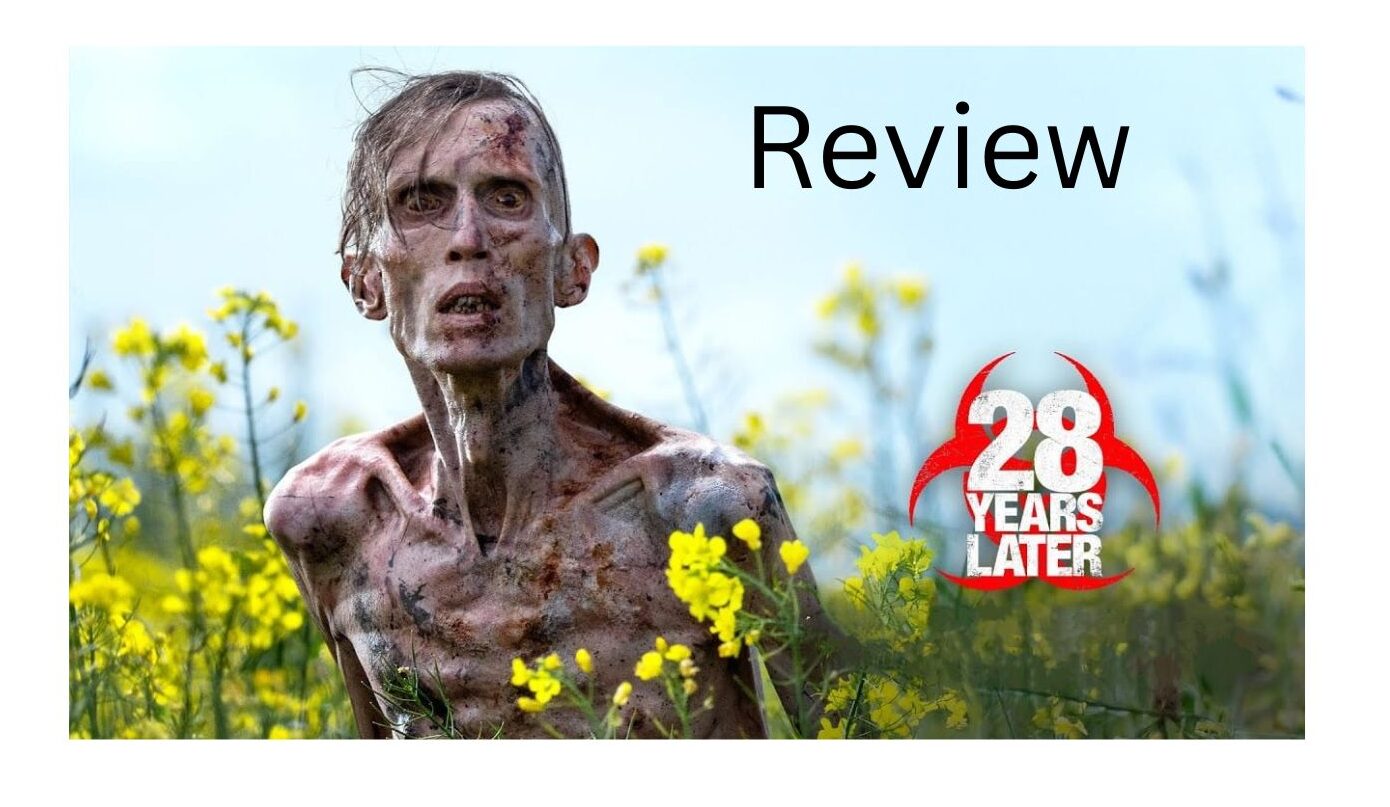
28 Years Later Review: In a time when sequels often rely on nostalgia and formula, 28 Years Later takes a more unpredictable route, one that’s rough-edged, strange, and at times unnervingly personal.
Directed by Danny Boyle, who returns after decades away from the franchise, this third chapter in the viral outbreak series doesn’t aim for blockbuster sheen. Instead, it embraces a grim, low-fi intensity that feels closer to guerrilla filmmaking than Hollywood horror. The result is messy but frequently gripping.
Set years after society’s collapse, the film zooms in on a small, isolated community surviving in Britain, now completely sealed off from the outside world. The virus still lurks, but the real focus is on a young boy, Spike, and the crumbling worldview passed down by his survivalist father. What starts as a familiar survival tale becomes a much deeper exploration of belief, disillusionment, and generational reckoning.
The visual approach is jarring; much of the film is shot with smartphones, giving scenes a grainy, unstable texture. Some viewers may find this style distracting, but it lends an eerie immediacy that suits the story’s chaotic atmosphere. It’s less about clean narrative arcs and more about the raw emotion of a world that never really healed.
The film’s strength lies in its characters. Rather than world leaders or scientists, we follow ordinary people trying to make sense of a broken world. There’s a surreal quality to some of the encounters, including a reclusive doctor who may or may not hold the key to saving Spike’s mother. Performances are committed, if occasionally over-the-top, adding to the film’s dreamlike quality.
Rather than lean into post-pandemic commentary, 28 Years Later sidesteps easy metaphors. It hints at broader political fractures, the isolation of nations, and the myth of safety without spelling them out. This ambiguity might frustrate some, but it also gives the film room to breathe.
What’s most surprising is how emotionally charged the film becomes. Beneath the horror, there’s a quiet story about growing up in a world shaped by fear and myth. The rage here is not just viral; it’s cultural, generational, and deeply human.
Is it perfect? Not by any stretch. But it’s daring, unconventional, and deeply rooted in the anxieties of our time. 28 Years Later doesn’t try to give easy answers; it just shows a world where survival has replaced meaning and asks whether that’s enough. Not for the squeamish. But worth the risk.
Rating: 2/ 5