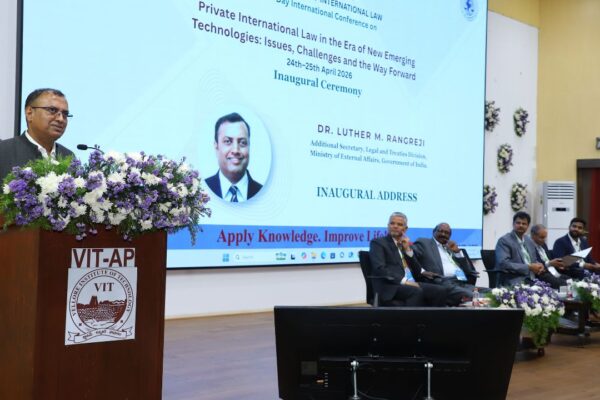
VIT-AP Amaravati, April 24, 2026: The School of Law at VIT-AP University, in collaboration with the Indian Society of International Law, MLS Company and Law Firm inaugurated the Two-Day International Conference on “Private International Law in the Era of New Emerging Technologies: Issues, Challenges and the Way Forward” on April 24, 2026, at the Tanguturi Prakasam Auditorium. The event brought together academicians, legal experts, researchers, and students from across the globe to deliberate on the evolving intersections of law and technology over the two-day conference.
The Inaugural Address was delivered by Dr. Luther Rangreji, Additional Secretary, Legal and Treaties Division, Ministry of External Affairs, Government of India.
“As digital ecosystems transcend national boundaries, international legal cooperation becomes more crucial than ever in addressing emerging challenges effectively,” he observed. Organizations such as the United Nations Commission on International Trade Law and the International Institute for the Unification of Private Law actively address cross-border legal issues. However, their collaboration is not based on a single unified treaty; rather, they work in coordination, each contributing within its area of expertise.For instance, UNCITRAL focuses on making cross-border transactions more legally workable by developing frameworks and model laws, particularly in areas such as electronic commerce and digital transaction
The Guest of Honour, Dr. V.G. Hegde, Executive President of ISIL and Professor at JNU, said that the Private international law, though closely connected to public international law, operates as a distinct field. It is essential for students to clearly understand the difference between private international law and domestic law. In essence, private international law lies at the intersection of private law and international law, dealing with legal issues that arise across national borders.
It governs cross-border transactions and disputes involving individuals and private entities. In such matters, the state is not always the sole or central actor; rather, it may be one among several participants, alongside private parties. Importantly, the scope of private international law extends beyond trade and commercial transactions to include personal matters such as divorce, adoption, and family-related disputes that involve more than one jurisdiction.
In his Presidential Address, Dr. P. Arulmozhivarman, Vice-Chancellor of VIT-AP University, spoke about the role of academia in shaping legal discourse.
“Universities play a critical role in bridging theory and practice, and platforms like this conference enable meaningful contributions to global legal development,” he said. “Private international law has traditionally dealt with questions of jurisdiction, choice of law, and the enforcement of foreign judgments. However, in today’s digital era, it faces unprecedented challenges arising from cross-border transactions and the complexities of rapidly evolving technologies. One of the key issues is the lack of interoperability across legal systems of different countries, which calls for greater international cooperation and innovative legal thinking.”
Delivering the welcome address, Dr. Benarji Chakka, Dean of VIT-AP School of Law, emphasized the growing relevance of private international law in a rapidly digitizing world.
“As emerging technologies reshape global interactions, it is imperative for legal frameworks to evolve in addressing cross-border challenges with clarity and foresight,” he noted.
Mr.Manimuthu Gandhi Vice president for Indian Society of International law, highlighted the institution’s commitment to academic excellence and global engagement. “This conference reflects its dedication to fostering meaningful dialogue on contemporary legal issues that have global implications,” he stated. This conference marks an important step in advancing dialogue and research in private international law amid technological transformation,” he said.
The ceremony concluded with a felicitation of the dignitaries and a vote of thanks by Dr. Bensha C. Shaji, who expressed gratitude to all participants and organizers.