
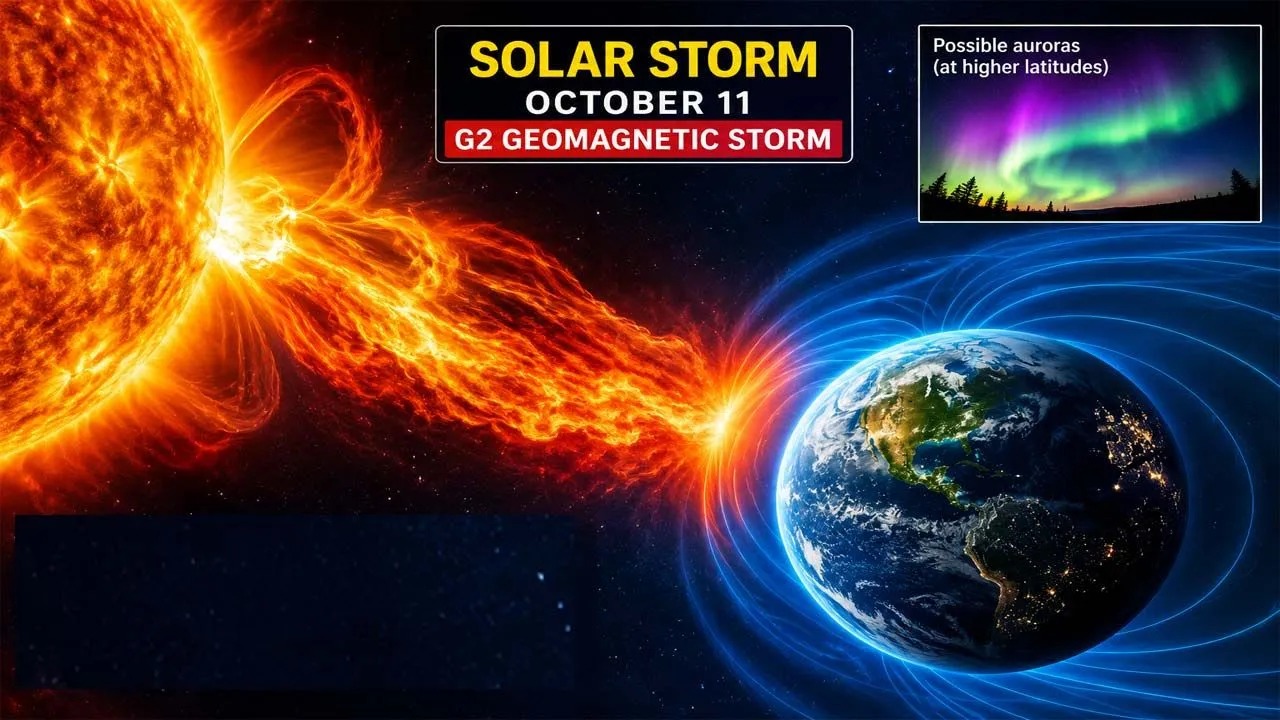
Scientists predict that a powerful solar storm will hit the Earth on October 11 (Sunday). They said that two large emissions from the sun are heading towards the Earth. Scientists predict that changes in the Earth’s magnetic field are likely to occur on October 11. The US National Oceanic and Atmospheric Administration (NOAA) has issued a warning of a medium-level G2 geomagnetic storm in this context.
It is estimated that the impact of this solar storm may have some effect on satellites, radio communication systems, and navigation services. However, it is said that the actual impact will depend on how the material coming from the sun interacts with the Earth’s magnetic field.

What is a solar storm?
Due to intense activity on the sun, energy and electrically charged particles are released into space. The most important of these is the coronal mass ejection (CME). It’s a huge cloud of electrically charged particles and magnetic material emitted from the sun. When such clouds reach Earth, they can affect the Earth’s magnetic field. This can cause geomagnetic storms.
NOAA classifies these storms into five levels. G1 is the mildest level, and G5 is the most severe. The likelihood of impacts and disruptions increases as the level increases. Solar radiation storms are assessed differently from S1 to S5, and radio blackouts from R1 to R5. These indicate different developments in the space environment.
What could happen on October 11?
According to the NOAA Space Weather Prediction Center.. Two emissions from the sun are coming towards Earth on October 7 and 8. The second emission is moving faster than the first. It is estimated that the two are likely to merge before reaching Earth. As this material approaches Earth, its speed and magnetic properties will be examined to further clarify the storm’s intensity. Current estimates are that there may be moderate-level impacts.
Impact on satellites and radio signals?
The effects of a G2 solar storm are usually more visible in high latitudes. There are potential for voltage fluctuations in power systems in those areas. Changes may need to be made to the operation of satellites. In some areas, there is a possibility of a decrease in the strength of radio signals and temporary changes in the accuracy of satellite navigation. However, these are possibilities. It cannot be said that every G2 storm will definitely cause disruptions.
During solar storms, colorful lights called auroras can be seen in the sky. These light displays are formed when electrically charged particles from the Sun interact with gases in the Earth’s atmosphere. Auroras, which are usually seen near the polar regions, can also be seen in areas with lower latitudes than usual when the storm is at its strongest. However, where the auroras will be seen this time depends on the intensity of the storm and other space weather conditions.
How much impact on India?
According to current estimates, there are no indications that this G2 solar storm will have a major direct impact on the daily lives of ordinary people in India. There is no need to expect power outages or complete disruption of communication systems across the country. This warning does not mean that auroras will be visible in all parts of India. NOAA will have to review the latest forecasts as conditions may change by the time the storm reaches land. The current warning is only an estimate. The full extent of the solar storm will only be known once it is clear how the material from the Sun interacts with the Earth’s magnetic field.
Multiple solar storms have launched from the Sun over the last few days, and the first #spaceweather impacts have begun here at 1 AU as more waves of plasma are soon to arrive. NOAA expects minor to moderate (G1-G2) geomagnetic storming, and it’s possible it goes higher… https://t.co/tcZs8bCmZo
— Stefan Burns (@StefanBurnsGeo) October 9, 2026