Seventeen years after the release of 2012, the Hollywood disaster film has returned to public discussion for an unexpected reason. A devastating event in the mountains of Nepal has brought back memories of the film’s terrifying scenes of collapsing mountains, rushing water and melting ice.
The connection may look striking at first. In both cases, mountains appear to give way, huge volumes of water surge through valleys and human settlements struggle against the force of nature. That visual similarity has led some people to wonder whether the film somehow anticipated the disaster that unfolded in Nepal.
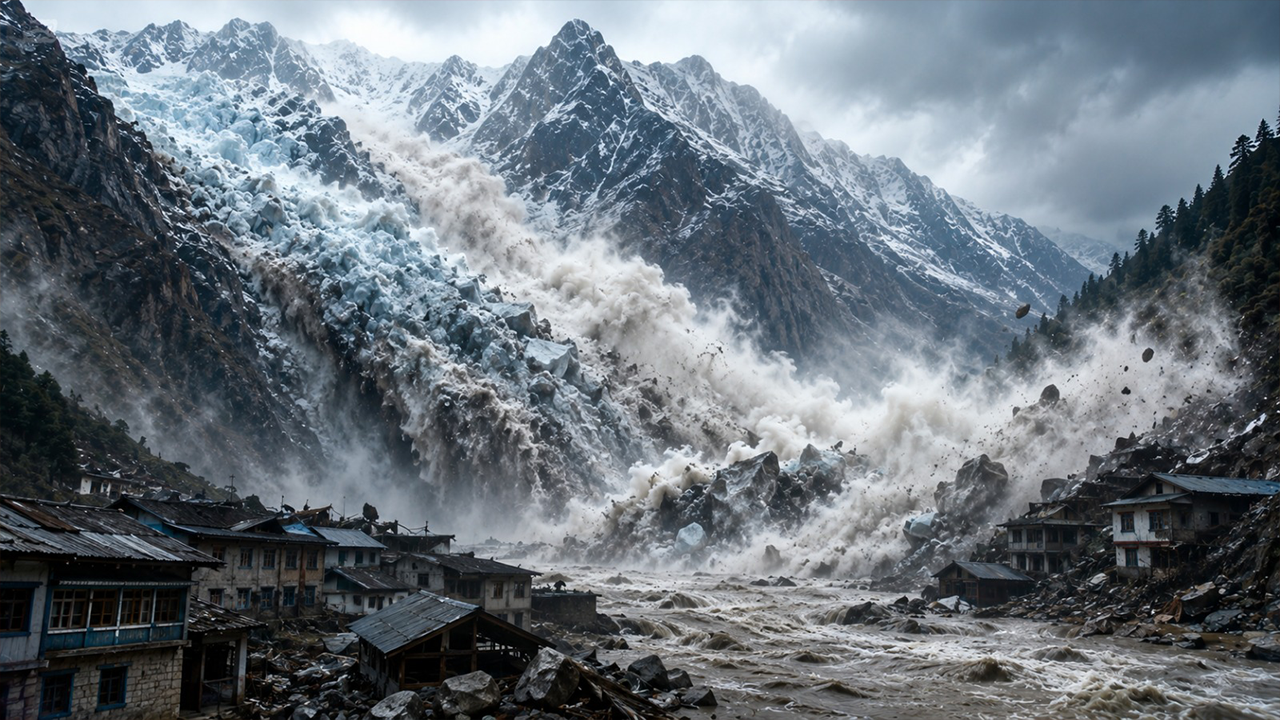
The event took place on August 26 near the Langtang Lirung region of Nepal. A massive mass of ice broke away from the mountain, triggering a powerful flow toward the rivers below. In some areas, water levels rose by several metres within minutes. Roads, bridges, homes and other infrastructure were unable to withstand the sudden force of the flow.
The combination of ice, rock, mud and water transformed parts of the mountain valleys within a short period. Videos of the destruction quickly reminded viewers of 2012, a film built around a fictional global catastrophe in which the natural world overwhelms cities and human civilisation.
Did 2012 Predict Nepal’s Mountain Disaster?
The comparison became even more striking because the film itself features the Himalayas prominently. In the story, enormous structures designed to preserve human life during a global catastrophe are located in the Himalayan region.
The film was inspired by fears surrounding the Mayan calendar and the widely circulated claim that the world would end on December 21, 2012. Director Roland Emmerich had described the concept as a modern version of the story of Noah’s Ark, turning the idea of an apocalyptic flood into a large scale Hollywood disaster.
That background has made the recent Nepal footage particularly evocative for some viewers. Images of a real mountain disaster placed alongside scenes from the fictional film can create an uncanny visual resemblance. One shows an actual mountain releasing ice, rock and water, while the other depicts a digitally created world facing catastrophic destruction.
The similarity, however, does not mean that the film predicted the Nepal disaster. There is no scientific evidence that 2012 anticipated the specific event that occurred in the Langtang Lirung region.
The science behind Nepal’s mountain disaster:
Scientific observations indicate that a huge combination of ice and rock collapsed from the mountain and moved rapidly downhill. The resulting mixture of ice, rock and mud generated a powerful flood as it travelled towards lower areas and river systems.
Scientists have also warned for years that rising temperatures, changing snow and ice conditions and alterations in glaciers can increase the risks associated with mountain hazards. These changes can make already unstable high mountain environments more vulnerable to sudden events.
The disaster has also prompted some people to search for explanations involving planetary movements, eclipses and the positions of planets such as Saturn. But those ideas do not provide scientific evidence that the event was predicted through astrology or planetary activity. The stronger explanation lies in the changing physical conditions of the Himalayan environment.
The reason 2012 feels connected to the Nepal disaster is therefore less about prediction and more about how people process frightening events. When something disturbing happens, the human mind often searches for familiar images, stories or warnings that can help make sense of it. A disaster seen in real life can easily bring back memories of a disaster previously watched on screen.
The Nepal incident is ultimately a story about a real and changing mountain environment rather than a Hollywood prediction coming true. The film ended when audiences left theatres years ago, but the physical processes shaping the Himalayas continue. Snow and ice continue to change. Mountains continue to evolve. Rivers continue to carry the effects of those changes downstream.
So the more important question is not whether 2012 saw Nepal’s future. It is whether people will pay closer attention to the changes taking place in the Himalayas before more such disasters occur.