Robots are now getting married, too. Although humanoid robots cannot yet perform all the tasks humans do, this attempt at marriage stands as a testament to how much they have advanced. Humanoid robots are evolving rapidly across the globe. Amidst this, news from Russia has captured public attention.
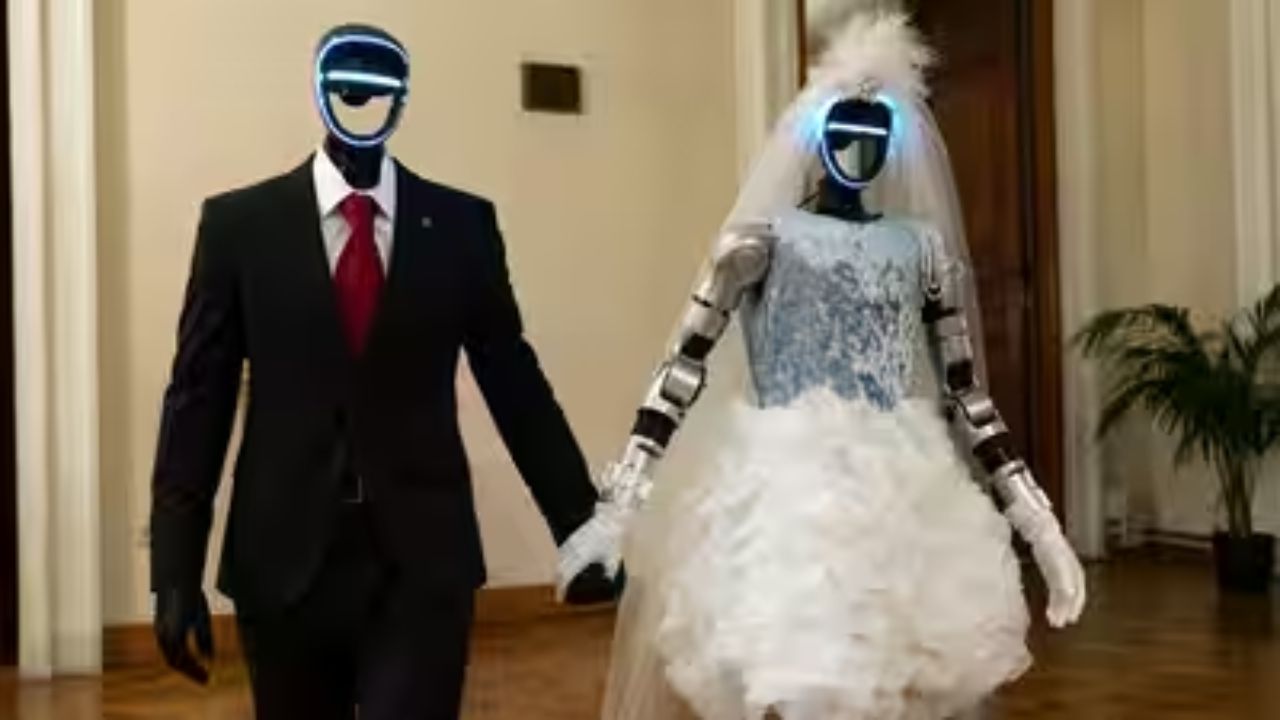
A “marriage” between two humanoid robots took place for the first time in Moscow. During the ceremony, the two robots exchanged vows and wedding bracelets, and were officially declared a “robot couple.” The wedding was held at the Pushkin Library in Moscow, the Russian capital. The robots were named Robert and Matilda; they had previously been showcased at the St. Petersburg International Economic Forum (SPIEF).
Robert was modeled after an office worker and blogger, while Matilda’s design was inspired by a ballet dancer. During the ceremony, the robots exchanged wedding vows using dialogue generated by AI. Instead of rings, they exchanged bracelets. Interestingly, the wedding bracelets were brought in by a robotic dog. Afterward, the ceremony officiant declared them “robot husband and wife.”
If you are wondering whether robots are actually getting married, the answer is no; this was not a legally binding marriage. This event was intended to draw attention to humanoid robots and artificial intelligence-based technology. IT-Imperial, the robotics company behind the initiative, states that such events help the public understand that in the future, robots will not be confined to factories but will be capable of performing various tasks in everyday life.
Many of the world’s largest tech companies are rapidly developing humanoid robots. Organizations such as Tesla (with Optimus), Figure AI, Unitree, Boston Dynamics, and others are creating robots capable of walking like humans, carrying objects, and performing various tasks. Thanks to the rapid advancement of AI, the capabilities of these robots are constantly expanding. However, it will take time for this technology to become an integral part of daily life. Current humanoid robots remain expensive and are primarily used for demonstrations, research, or specialized factory tasks.
Against this backdrop, the robot wedding held in Russia served as a technological showcase rather than an indication that robots would soon lead human-like lives. Nevertheless, such events undoubtedly demonstrate that AI and robotics are advancing at an unprecedented pace. Humanoid robots featuring textures resembling human skin are being developed in various places; these robots closely mimic humans in both appearance and facial expressions.