
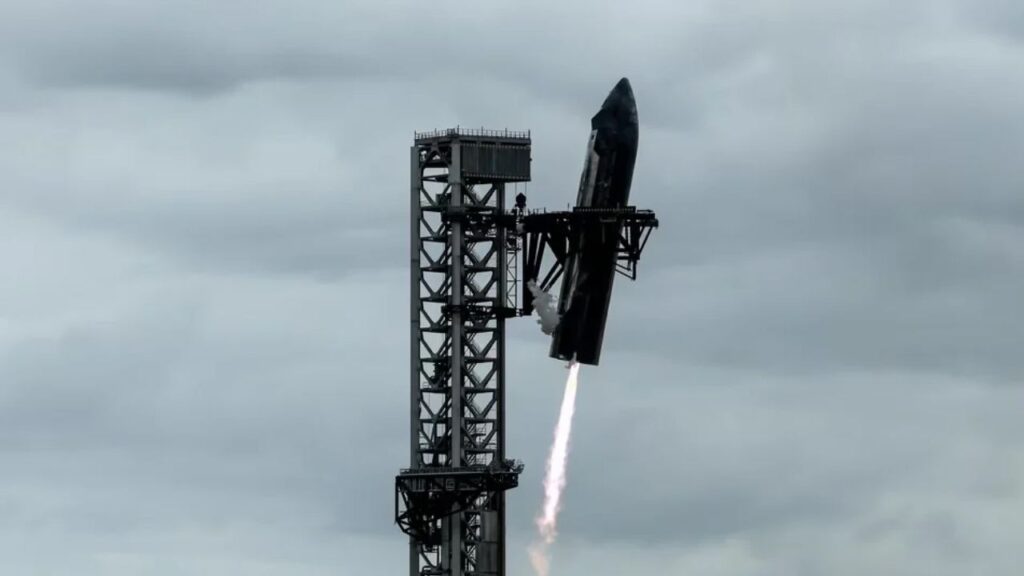
SpaceX has reached a big milestone. When the Starship rocket came back to Earth, its upper stage was caught in the air by huge mechanical arms on the launch tower. This is a major step in SpaceX’s plan to reuse its rockets.
How the catch worked
SpaceX launched the 407-foot-tall Starship from its Starbase site in Texas. The rocket has two parts. The lower part is the Super Heavy booster, and the upper part is the Starship itself. In space, the Starship released 26 new Starlink satellites and then began its trip home.
It spent more than 22 hours in space and went around the Earth 14 times. It came back into the atmosphere at about 17,000 miles per hour. It survived the extreme heat, restarted its engines and flew back to the launch tower. There, the tower’s giant arms, nicknamed “Mechazilla,” caught it. This was a big win for SpaceX, because the rocket landed at the launch site and was not dropped into the ocean.
Why the booster failed
The upper stage came back safely, but the effort to recover the Super Heavy booster failed. On its way back, the booster’s engines shut off too early, and its systems found a fault. Instead of flying to the tower, it turned toward the Gulf of Mexico and was destroyed there. SpaceX engineers are now looking into the cause. So the goal of recovering both parts in one flight has still not been met.
The big goal: humans on the Moon and Mars
The Starship’s safe return is an important step toward sending people to the Moon and Mars. If the rocket can be fully reused, the cost of space travel could fall by a lot. Under its Artemis programme, NASA is working with SpaceX to build the Starship into a lander that can take astronauts to the Moon. NASA’s latest plan says Artemis-3 in 2027 will be mostly about key technical tests, and Artemis-4 in 2028 aims to land humans on the Moon.
Building human settlements on Mars is still a long-term dream for Elon Musk. Even so, catching the Starship in mid-air is a historic step. Big challenges remain, such as recovering both parts and flying them again at low cost.