
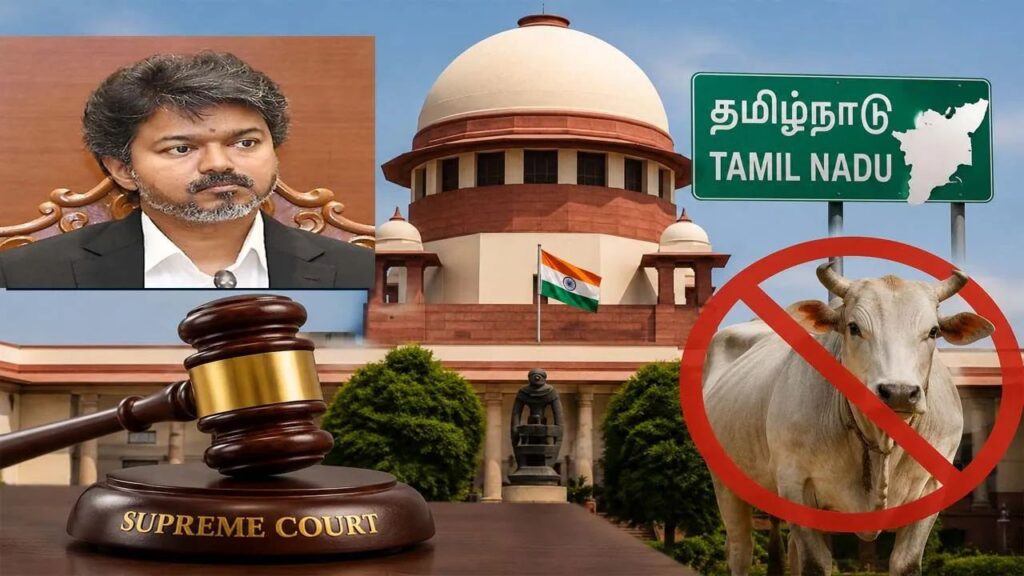
The Tamil Nadu government has received significant relief from the Supreme Court. On Monday, the apex court temporarily stayed the implementation of the Madras High Court’s order prohibiting the slaughter of cows and calves in the state on any day, including Bakrid. Hearing the petition filed by the Tamil Nadu government challenging the High Court’s order, the Supreme Court issued notices to the respondents and granted a stay on the High Court’s directives pending further hearing.
A bench comprising Justice Vikram Nath and Justice Sandeep Mehta heard the case. Observing that the High Court’s order required modification, the Supreme Court announced an immediate stay on its implementation. The state government had approached the Supreme Court about two weeks ago. In its petition, the government argued that the High Court’s imposition of a blanket ban was contrary to the law, noting that the Tamil Nadu Animal Preservation Act, 1958, permits the slaughter of cows under specific circumstances.
What does the 1958 Act say?
Under the Tamil Nadu Animal Preservation Act, the slaughter of cows is permitted only under certain specific conditions. Specifically, slaughter is legally allowed if the cow is over 10 years old, is completely unfit for breeding or agricultural work, and a certificate to this effect has been obtained from the concerned authorities. However, on May 27 of this year, a Madras High Court bench comprising Justice G.R. Swaminathan and Justice V. Lakshminarayana issued key directives. While stipulating that animal slaughter must take place only in officially recognized slaughterhouses, the court ordered the State Chief Secretary and senior police officials to take measures to prevent the slaughter of cows and calves—not just on Bakrid, but on any day in the future. The High Court also directed that appropriate instructions be issued to officials to ensure the implementation of these orders across the state.
The Government’s Argument
The Tamil Nadu government informed the Supreme Court that the High Court’s orders were contradictory. It argued that imposing a blanket ban while simultaneously acknowledging instances where slaughter is legally permitted amounted to exceeding the scope of the law. Surya, the State General Secretary of Indu Makkal Katchi, had filed a petition in the High Court alleging the illegal slaughter of cows in public places. He stated that although complaints had been lodged with officials regarding this matter, no action had been taken. During the hearing, the High Court cited Article 48 of the Indian Constitution. Article 48 directs state governments to take measures to prohibit the slaughter of milch cattle, calves, and animals used for agriculture. While this provision is part of the Directive Principles of State Policy, it is legally established that these principles are not rights directly enforceable by courts.
The Supreme Court has issued notices to the respondents regarding the petition filed by the Tamil Nadu government. It clarified that the Madras High Court’s order imposing a total ban on cow slaughter would not remain in force until further orders are issued.