
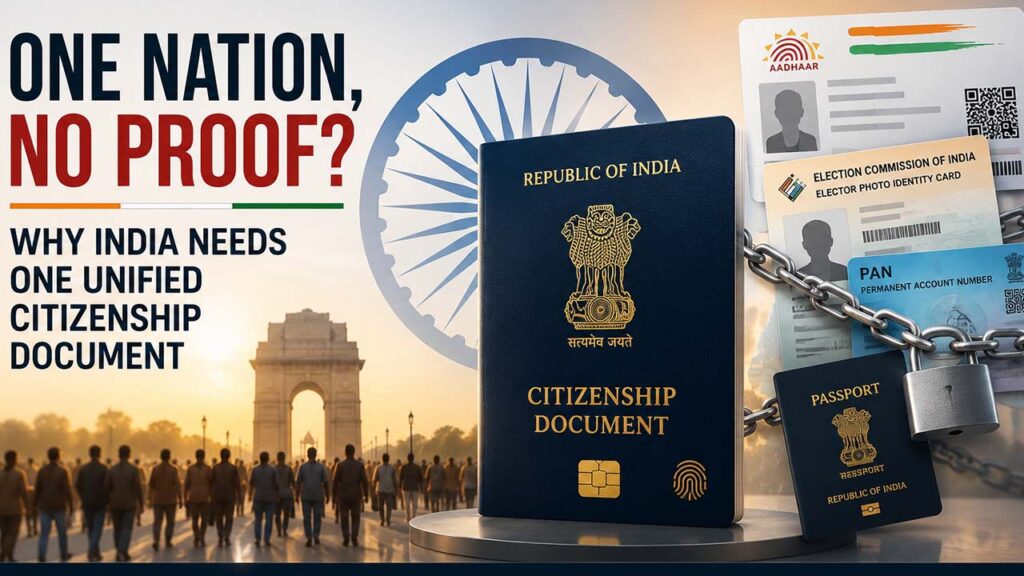
The Ministry of External Affairs recent clarification that an Indian passport is mainly for travel, not a final proof of citizenship, has stirred up a new round of debate about how India defines identity. Even with lots of official papers in circulation, India still seems to miss a single document that is legally final and universally accepted as citizenship.
Why India Need One Unified Citizenship Document
Most people in India end up using Aadhaar, Voter ID, PAN, and passports depending on what the task is. Yet each one is built for a particular purpose, so none of them alone works as definitive proof of citizenship. In real life this creates awkward confusion during legal checks or administrative verification, because different offices often ask for different things, and then everyone ends up saying “but I have the ID , it should be enough.”
Why a unified citizenship document could help
A dedicated citizenship card or document could act like the one authoritative proof of nationality, so officials would not have to juggle multiple IDs just to confirm who a person really is. That could make official work smoother, identity checks quicker, and government services clearer and less inconsistent.
Also, it’s worth remembering that Section 14A of the Citizenship Act already talks about compulsory registration of citizens and the issuance of a National Identity Card. So the idea isn’t entirely new, it just hasn’t become fully settled in practice.
Better security and more efficient governance
In theory, a unified system could reduce identity fraud, and make fake identities harder to assemble with forged documents. Beyond security, it could also help welfare delivery, recruitment in public sector roles, school admissions , and other government services by lowering duplication across databases and cutting down on mismatches.
The implementation hurdle
Of course, building a nationwide citizenship registry is not a small thing. Many Indians , especially in rural places, still do not have birth certificates or older records that can be traced back. If the documentation rules are too strict, genuine citizens could get sidelined unintentionally, unless the process is flexible, transparent, and backed by proper support.
Privacy concerns
Centralizing citizenship data would mean storing sensitive personal details in one place. That makes cybersecurity and data protection a non optional requirement. Strong legal safeguards, plus independent oversight, would be needed to stop misuse and to protect citizens privacy, not just promise it.
Where things could go from here
A unified citizenship document could modernize India administrative systems, reduce legal ambiguity around citizenship, and improve how governance actually functions. But whether it works well will depend on an inclusive verification process, one that balances national security with constitutional rights, and also takes privacy seriously , not as an afterthought.