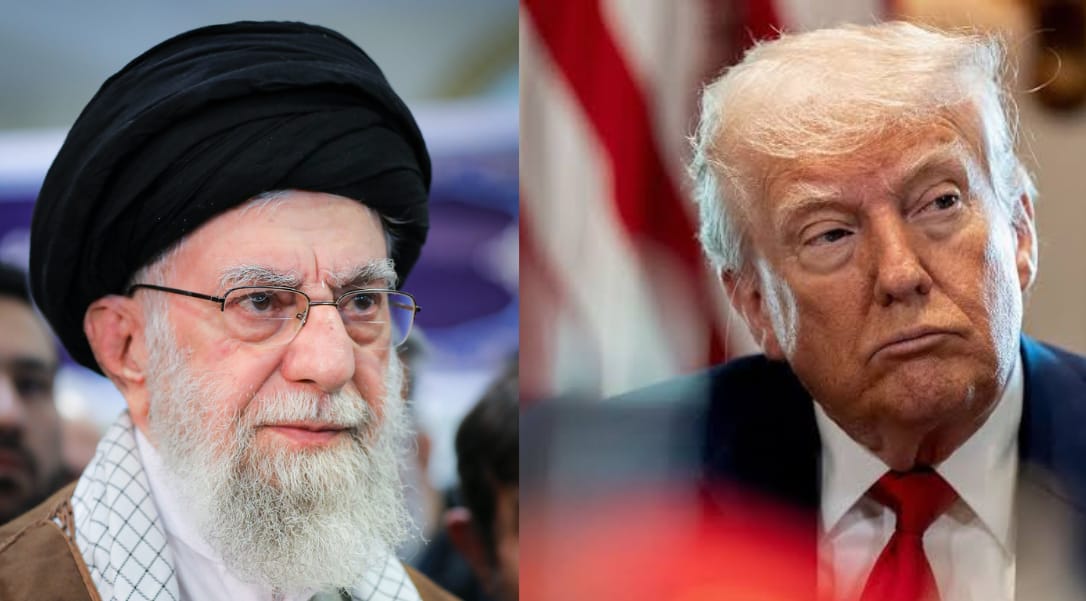
US President Donald Trump has warned Iran, revealing that American intelligence knows the exact location of Iran’s supreme leader, Ayatollah Ali Khamenei. However, Trump said the US has chosen not to strike—“at least not for now.”
Posting on his Truth Social account, President Trump said, “We know exactly where the so-called ‘Supreme Leader’ is hiding. He is an easy target but is safe there—we are not going to take him out (kill!), at least not for now.” He added, “But we don’t want missiles shot at civilians or American soldiers. Our patience is wearing thin. Thank you for your attention to this matter!” The remarks come as the conflict between Israel and Iran intensifies, now in its fifth day. Over 200 people have been killed in Iran—most of them civilians—while at least 24 civilians have died in Israel amid continuing missile and drone attacks from both sides. “Not a Ceasefire—An End”
Speaking to reporters aboard Air Force One, President Trump said the US was not just seeking a ceasefire. “We’re looking at better than a ceasefire,” he said. “A real end. Not a ceasefire. An end.”
His comments signal a hardening US stance, particularly around Iran’s nuclear activities, which Trump has repeatedly called a “red line.” In a separate social media post, he declared, “IRAN CAN NOT HAVE A NUCLEAR WEAPON. I said it over and over again! Everyone should immediately evacuate Tehran!”
Israeli Plans and Trump’s Veto: Recent reports claim that Israel had proposed assassinating Ayatollah Khamenei. President Trump reportedly vetoed the plan, concerned it would further inflame the conflict. A senior US official, quoted by Reuters, said, “Have the Iranians killed an American yet? No. Until they do, we’re not even talking about going after the political leadership.”
Israeli Prime Minister Benjamin Netanyahu has neither confirmed nor denied the plan. In interviews with both ABC News and Reuters, he defended Israel’s air strikes on Iran and warned of the risks of Iran’s nuclear ambitions.
“They chant ‘Death to Israel, death to America.’ If we don’t stop them, they’ll bring their terror to your shores,” Netanyahu said. “Today, it’s Tel Aviv. Tomorrow, it’s New York.”
He added that Israel had kept the US fully informed of its military operations and rejected renewed nuclear negotiations with Iran, calling them a “cover for lies and delay.”
In response, Iran has appealed to regional countries, including Saudi Arabia, Qatar, and Oman, to intervene. Iranian Foreign Minister Abbas Araqchi posted on X (formerly Twitter): “If President Trump is genuine about diplomacy and interested in stopping this war, next steps are consequential. Israel must halt its aggression, and absent a total cessation of military aggression against us, our responses will continue.”
Iran has continued to launch missile and drone attacks on Israeli cities, including central urban areas. Tehran has framed its actions as retaliation for Israeli air strikes that have hit both military and civilian targets.
With both Washington and Tehran taking firm positions and violence escalating, the possibility of wider regional conflict remains high. While some regional powers are attempting to mediate, President Trump has shown no interest in compromise—insisting on what sources close to the White House have called an “unconditional surrender” from Iran on its nuclear programme.
As the world watches closely, the coming days could prove critical in determining whether diplomacy has any chance—or whether full-scale war is on the horizon.