
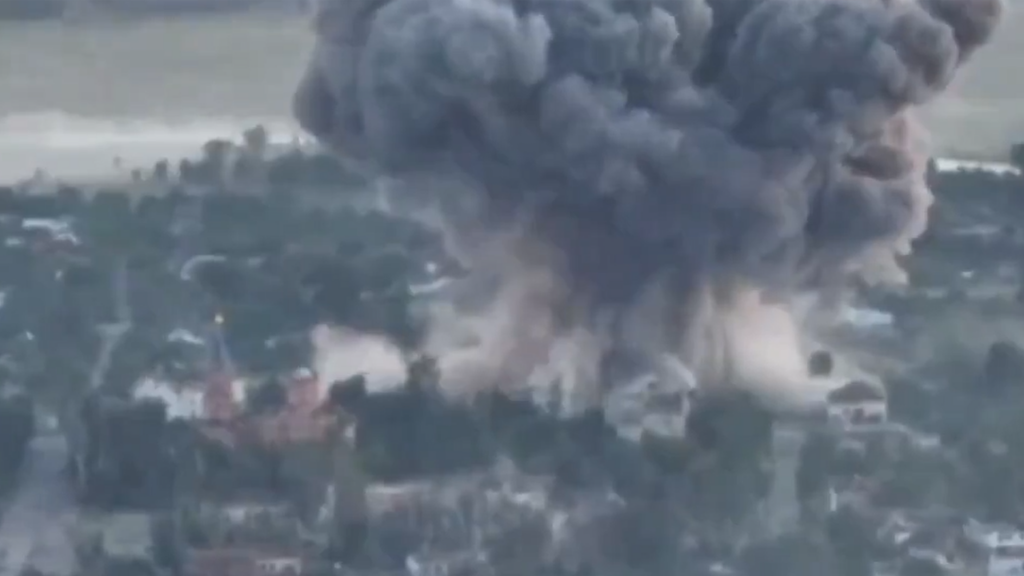
Russia has once again demonstrated the destructive power of one of its largest conventional weapons by deploying the FAB 3000 glide bomb against targets near the frontline town of Orikhiv in Ukraine. Footage released by the Russian Defence Ministry showed an enormous explosion, a rapidly expanding blast wave and thick black smoke rising into the sky, drawing global attention to the return of this Cold War era weapon.
Russia’s Soviet-Era Weapon FAB-3000 Bomb Revived
The strike comes at a time when Ukraine has intensified long range drone attacks on Russian energy facilities and military infrastructure. Moscow has vowed stronger retaliation following those operations, and the renewed use of the FAB 3000 signals a shift in Russia’s battlefield strategy as the conflict continues to evolve.
What Makes the FAB 3000 So Powerful?
The FAB 3000 is a Soviet designed high explosive aerial bomb weighing around 3,000 kilograms. Nearly 1,200 to 1,400 kilograms of that weight consists of explosive material, while the rest is made up of a heavy steel casing designed to maximize destructive force.
Unlike smaller aerial bombs, the FAB 3000 is built to destroy reinforced bunkers, underground shelters, military headquarters, industrial facilities and fortified defensive positions. When it detonates, it generates an intense blast wave capable of collapsing concrete structures, crushing trenches and creating massive craters. Although it is not a nuclear weapon, it ranks among the most destructive conventional bombs currently used in modern warfare.
Originally developed during the Soviet era, the bomb saw combat in Afghanistan during the 1980s before gradually disappearing from active service. It returned to the battlefield after Russia launched its full scale invasion of Ukraine in 2022.
Russia later upgraded the weapon with the Universal Planning and Correction Module (UMPK), a guidance and wing kit that transforms the bomb into a precision glide weapon. This allows aircraft to release it from dozens of kilometres away, reducing the risk of entering the range of Ukrainian air defence systems while still striking designated targets with greater accuracy.
Russia released footage of a 3-ton FAB-3000 glide bomb striking the front-line town of Orikhove in Ukraine’s Zaporizhzhia region. The bomb carries around 1.4 tons of explosives. pic.twitter.com/dZ1xMf6ix3
— Open Source Intel (@Osint613) July 13, 2026
Why Russia Has Brought Back a Cold War Weapon
Military analysts believe economics is one of the biggest reasons behind the FAB 3000’s return. Producing advanced cruise and ballistic missiles is expensive and time consuming. By fitting guidance kits to existing Soviet era bomb stockpiles, Russia can field powerful stand off weapons at a much lower cost while preserving its supply of sophisticated missiles.
The renewed emphasis on glide bombs also reflects changing battlefield tactics. Rather than relying solely on precision missiles, Russia is increasingly using large guided bombs to target fortified Ukrainian positions from safer distances. This approach enables Russian aircraft to remain outside much of Ukraine’s air defence coverage while maintaining sustained aerial pressure.
At the same time, Ukraine continues expanding its long range drone campaign, striking oil refineries, fuel depots and military facilities deep inside Russian territory. These operations are intended to disrupt logistics, weaken energy infrastructure and increase the cost of the war for Moscow.
The conflict is now becoming a contest between two very different military technologies. Ukraine is relying more heavily on long range drones capable of reaching strategic targets, while Russia is reviving massive Soviet era bombs and combining them with modern guidance systems. The result is a battlefield where decades old weapons are being transformed into precision strike platforms, making the war increasingly destructive and technologically complex.