
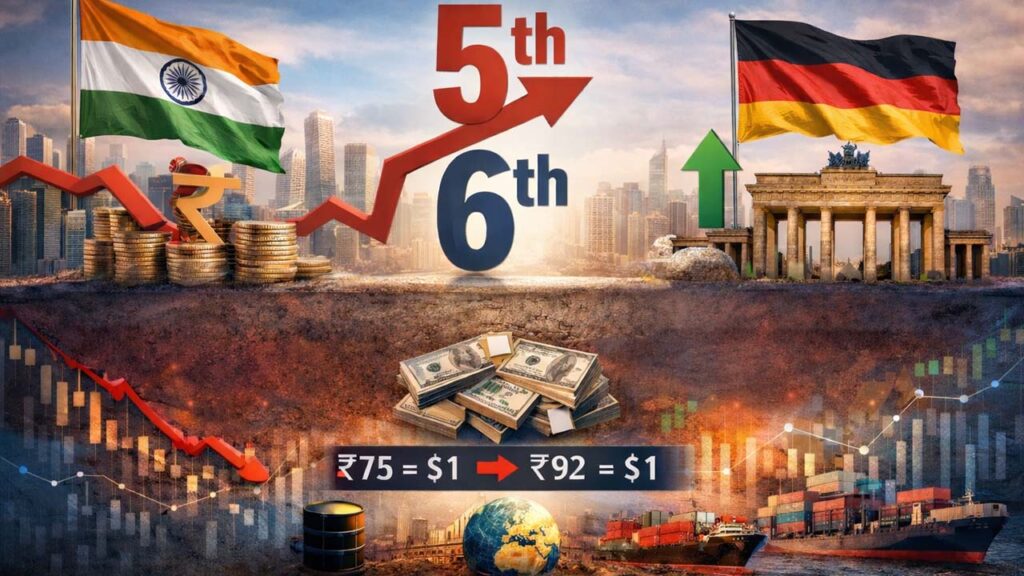
India Drops To 6th Largest Economy: India remains one of the fastest-growing major economies yet it has slipped from 5th to 6th place in global GDP rankings. The situation appears to be a setback but it requires detailed examination because economies use different methods for their worldwide economic assessment.
India Drops To 6th Largest Economy
India’s nominal GDP currently amounts to approximately $3.6–3.7 trillion according to recent estimates while Germany has achieved a GDP of approximately $4.4–4.5 trillion.
India maintains its growth rate between 6.5% to 7% yearly while Germany experiences much slower economic expansion that ranges between 0% to 1%. The situation presents a paradox because India exhibits faster growth yet maintains a smaller total size compared to other countries.
Currency Depreciation Impact
The Indian rupee has lost value against the US dollar which serves as the primary factor that caused the decrease.
In 2021: ₹1 = $0.0135
In 2025–26: ₹1 = $0.012
The decline appears minor but it creates substantial economic impact because India loses one trillion dollars which leads to major drops in its GDP when converted to dollars for worldwide economic comparisons.
Nominal GDP vs Real Growth
Countries establish their international standings through nominal GDP measurements which use US dollars instead of actual economic output growth numbers.
India’s real GDP growth: Approx 6.5%–7%
India’s nominal GDP growth (USD terms): lower due to currency effects
Countries with stable or progressive currency systems maintain their nominal values at higher levels while experiencing reduced actual economic growth rates.
Germany’s Advantage in Stability
Germany benefits from a strong and stable currency (Euro) and a high-value export economy. The economy of Germany maintains its top ranking because every tiny growth in this huge economy adds to its economic value.
Per Capita Gap Still Wide
Population size serves as another fundamental element that determines this situation.
India’s population: Approx 1.4 billion
Germany’s population: Approx 84 million
India has a per-capita GDP of $2,500 while Germany exceeds $50,000 even though both countries show identical economic output gaps. The distribution of India’s growth across its larger population base results in lower economic productivity for each individual member.
Global Economic Conditions
The external factors that emerged during this time period also affected the situation:
India’s import costs rose because of increasing oil prices
Currency valuations changed because of global inflation
Trade routes sustained damage from geopolitical conflicts
Countries use nominal GDP measurements to establish their economic status which serves as the foundation for international economic comparisons.