
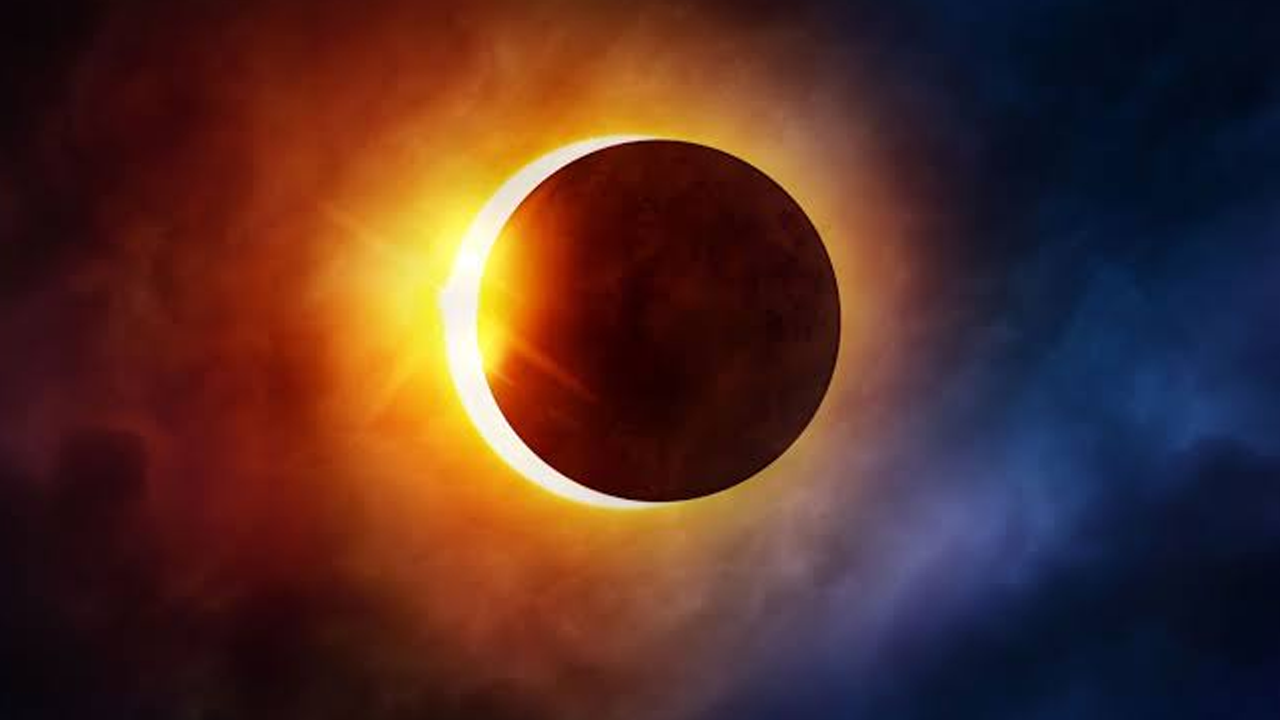
Long before calendars, clocks, and written history, people looked to the sky to understand the passage of time. The Sun guided daily life until rare moments when daylight suddenly faded, leaving ancient civilizations confused and fearful. What was once seen as a mysterious sign is now understood through the power of modern science.
Total Solar Eclipse 2026:
On August 12, 2026, the world will witness the only total solar eclipse of the year. Although millions of people are eagerly waiting for this remarkable event, it will not be visible from India. The eclipse will begin at around 2.30 pm Indian Standard Time, reach its maximum phase at about 5.15 pm, and conclude around 8.00 pm.
A total solar eclipse occurs when the Moon moves directly between the Earth and the Sun, casting its shadow on a narrow path across the planet. Observers located within this path experience the Sun being completely covered for a brief period, creating one of nature’s most spectacular astronomical events.
The path of totality on August 12 will pass across Greenland, Iceland, parts of the Atlantic Ocean, northern Spain, a small area of northeastern Portugal, and northern Russia. Partial phases of the eclipse will be visible across several parts of Europe, North America, and northwestern Africa. Since the Moon’s shadow will not cross South Asia, the eclipse will not be visible anywhere in India.
Beyond its visual beauty, the event offers an important opportunity for scientific research. During totality, the Sun’s outer atmosphere, known as the corona, becomes visible because the Moon blocks the bright solar surface. Scientists use these rare moments to study the Sun’s magnetic activity and observe how Earth’s atmosphere responds to the sudden reduction in sunlight. NASA is also preparing special observations using aircraft and high altitude balloons to collect valuable data during the eclipse.
Although ancient societies often regarded solar eclipses as signs of disaster or divine anger, modern astronomy has shown that they are entirely natural events caused by the precise alignment of the Earth, Moon, and Sun. Experts also remind sky watchers that looking directly at the Sun during any phase of the eclipse is unsafe. Certified eclipse glasses or specially designed solar filters are essential for safe viewing. Only people inside the path of totality may briefly view the eclipse without eye protection after the Sun is completely covered by the Moon.
The journey from fear to scientific understanding reflects humanity’s growing knowledge of the universe. Today, a total solar eclipse stands not as a symbol of mystery, but as a reminder of how science continues to unlock the secrets of the skies.